Cali, November 3, 1938 -
Bogotá, October 7, 2006, 11 PM.
... Goodbye
MAESTRO ...
We are deeply saddened ...
 The text that accompanies this photograph entitled "ALAPE, A PEN COURAGEOUS"

Alape
's coffin was carried to the burial of Christ Los Olivos. There boleros ring as he wanted. (Photo: Claudius Rubio-Weather)+ + +
TEXTS PRESS et al.
From: Maruja Vieira
Sent: Monday, October 9, 2006 6:03 pm
To: ntc@andinet.com
Subject: RE: Arturo Alape.
Dear Friends, I am also very sad
and, contrary to my custom made "a sea of \u200b\u200btears." No one was in a better light, back in 71, the output of Arthur, the historian, novelist, painter, of the place he called "the field." I have already written to Katia and Paloma. Let us fraternal condolences.
A hug from Maruja Vieira
bolero ALAPE
Cronopios , Virtual Journal. ignacioramirez@cable.net.co The novelero 688. October 9, 2005
At noon today (Oct. 9 / 06) the unburied corpse partner Arturo Alape will be removed from the burial room of La Candelaria, Los Olivos, of 98th Street and Avenue 18 in Bogotá, where he remained from yesterday at the Peace Gardens, further north of the capital, where he will be cremated and fired by their loved ones, including writers and Colombian artists, all friends and admirers.
This first part of the morning will boleros to remember and to symbolize the presence of his spirit, until the last moment was recreated sonera romantic music, much liked and which accompanied him until the last minute.
There will be readings and spontaneous expressions of remembrance around the friendship united by the word.
Yesterday, his son Manuel went to his house and brought some big pictures painted by her father. Also some photographs that show him in their creative tasks. And although his absence is felt strongly, no sadness. We'll sing boleros to fire ...
+ + +
GOODBYE TO THE 'FORGOTTEN MEMORY'
eltiempo.com / tiempoimpreso / edicionimpresa / Nation October 9, 2006
http://www.eltiempo .com/tiempoimpreso/edicionimpresa/nacion/2006-10-09/ARTICULO-WEB-NOTA_INTERIOR-3277517.html
Photos: Claudia Rubio-TIME
http://media.eltiempo.com/tiempoimpreso/edicionimpresa/nacion / 2006-10-09/IMAGEN/IMAGEN-3277526-2.jpg
http://media.eltiempo.com/tiempoimpreso/edicionimpresa/nacion/2006-10-09/IMAGEN/IMAGEN-3277526-1.jpg
Caption: The Alape coffin was carried to the burial of Christ the King Los Olivos. There boleros sounded like he wanted.
The author of 'The Bogotazo' died yesterday at age 67. He also distinguished himself as a painter and novelist. Is also remembered as the biographer Tirofijo.
"Today I wonder how I will resist and if the post-catch up to live, something that has long desire, to see a lasting peace to build a more just country."
So said Arturo Alape, Aug. 27, the last interview he gave to El Tiempo, during a tribute to his friends prepared for him.
His final saw coming. For several years, journalist, writer and painter suffered from leukemia that ended his life early yesterday morning, at age 67.
Those who knew about their work highlights their contribution to the contemporary history of Colombia, who captured in works such as The Bogotazo, memories from oblivion.
"Arturo always tried to understand the roots of our violence, says the historian Juan Carlos Florez. It was also the most serious student of personality Tirofijo. Although he had ideological sympathy, that does not detract from his effort to understand the character" .
To Flórez, another key feature of the work of Alape was the rigor, "brought to Colombia on investigative method that is to rescue the memories of people and placing them in a historical framework in order to preserve the memory of every age. "
The writer left his real name, Carlos Arturo Ruiz, in the 60's, when it was part of Communist Youth and knew the story of James Prías Alape, alias 'Black Charro', farmer co-founder of the FARC.
Alape, an authentic self, was also in the guerrillas until their spirit of intellectual journey took him through the final.
His son Manuel Ruiz, archivist and historian at the National University, notes that left an important file for the contemporary history of Colombia.
"I always had a great admiration for your work, school did several generations of writers and historians, "he says. In the last stage of his life he wrote five novels, which showed that artistic virtues can be found outside the academy. "
was known more as a writer, but also did painting in recent years." Creatively was tireless. He exemplifies what every journalist that can carry a hidden artist, "says Restrepo .
Within the work of Arturo Alape there are 23 books, ranging from anthropology and history to the painting. Last year he published his latest novel, The corpse unburied.
On account of its writings and his ideas, received threats and had to live for several years in exile on the island of Cuba and Germany.
yesterday, doing his will, his family and close friends gathered in front of the coffin, which was surrounded by photographs and paintings él.Mientras dear to the audience talking, they heard their favorite boleros. The first ring was the One 19. Today
their friends and family will bid farewell to a gathering and his wife read a text that he chose to say goodbye.
So said Alape
"For me the main, today is my work as a writer and painter, but I remain critical of what happens. "
" Today I do not justify any kind of war: the government or the insurgency. The country must be given a break with a political process to build peace with social characteristics.
"While many claim victory for what we have, I still think that I suffer from a certain historical sadness.
" With my work and my life has been social resistance, because my books have been very controversial and because I was the biographer of "Sureshot", a text widely read and highly paid. Charged me with the exiles. "
" One day I discussed with a group of protesters ... I discovered that there were other truths. That you see someone who has been an artist. "
+ + +
ALAPE, A PEN COURAGEOUS
DIED THE WRITER ARTURO ALAPE
EL PAIS, October 9, 2006, Living, p. 1 C
http://www.elpais.com.co/paisonline/ notas/Octubre092006/alape.html
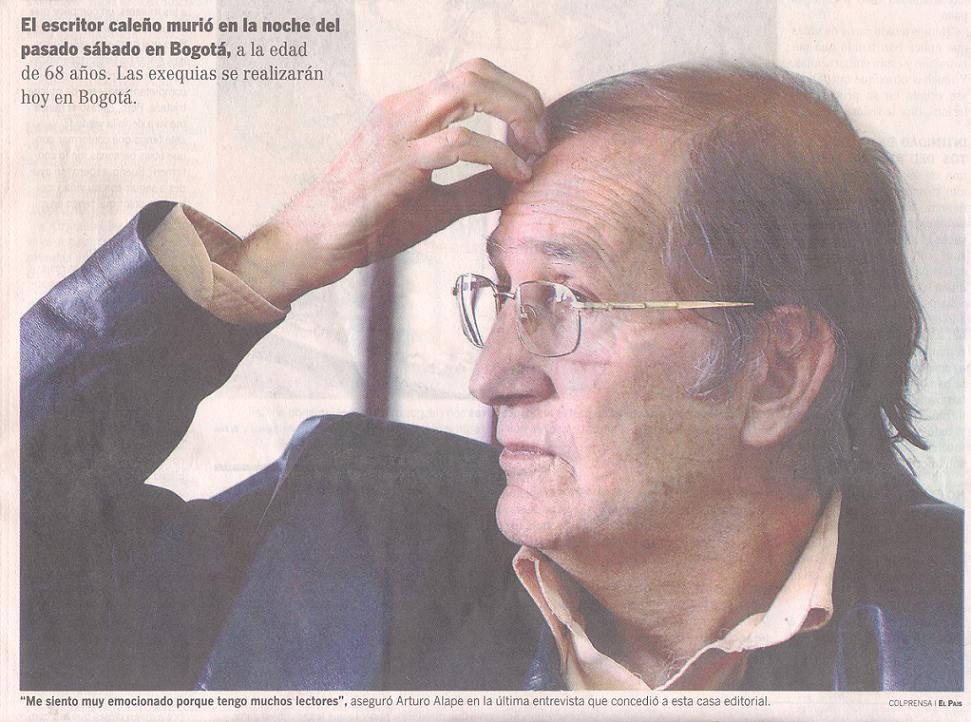
Photo: http://www.elpais.com.co/paisonline/fotos_notas/alape2.jpg "I am excited because I have many readers," said Arturo Alape in the last interview he gave to the publisher. Colprensa I
Arturo Alape El Pais, the author of The Bogotazo, the history book with the greatest number of publications in Colombia (17), once confessed to the country to write caused him anguish:
"I turn an antisocial, sack no gun or kill your neighbor, but I get into this process that is very passionate. It's like touching the skin to the imagination. "
However, writing and painting were two of his passions. For him there was no difference between color and word.
"The only this time is that when I write I sit and when I paint I stand, but for me the same thing. Do not know why some say why one is not dedicated to one or the other. If most journalists now are politicians, they are also parents and are loving, why you can not develop their artistic inclinations? ".
So was Carlos Arturo Ruiz, also known as Arturo Alape, who fought for a decade with leukemia who was suffering. Illness that kept interrupting his research and writing by having to spend weeks internship in hospitals in the nation's capital.
During the last year, writer, painter, historian and researcher originally from Cali, saw his condition deteriorated again, until last Saturday, at 11:00 pm, died after spending a week internship at the Clinic Corpas Jorge Oliveros, in northern Bogota.
In fact, in order to have the elements needed to keep fighting for his life, was in dire need for help from your colleagues, friends and admirers. Through the Teatro La Candelaria was a special season of theater for the benefit of the Colombian writer. Alape
entuteló last June, the EPS to which it was affiliated to give him the medicine that would help him stay alive. The cost of these drugs exceeded $ 14 million a month. Since the 60
Alape was devoted to the study and analysis of the violence that has plagued the country, not only from books, but to be a member of the Colombian Communist Youth, which allowed him to meet in the town in Tolima Marquetalia to Pedro Antonio Marín, 'Tirojifo' the head of the FARC.
Such relationships and some of his political positions, led him to live amid constant threats. In fact, he lived in exile in Germany and Cuba, and then perform several policy studies in the Soviet Union.
Professor of the leading universities in the country, wrote dozens of articles, about 23 books, among which are recognized the two bulky volumes of the biography The Lives of Pedro Antonio Marín, Manuel Marulanda Vélez-Tirofijo (1983), his historical essay The Bogotazo: Memorias del Olvido (1987), stories of Tirofijo Deaths and Diary of a Guerrilla, among others.
Last year he published his last novel unburied corpse, which recreates one of the events that were generated in the 50s, after the assassination of Liberal leader Jorge Eliecer Gaitan on April 9, 1948.
His life was divided between class and social issues and artistic projects.
As a painter, exhibitions in Europe, Cuba, Cali and Bogota.
The funeral was held in the funeral Los Olivos and his funeral was held today in Bogota.
YOUR LAST LEGACY. The unburied corpse was his last published novel. A story that haunted him for decades, as the recreation of historical fact, a complaint about an alleged state crime in the 50's, but with a strong relationship with the famous Bogotazo.
This was based on his research in the 70s all the facts surrounding the April 9, 1948.
To do this, he contacted the court reporter Felipe González Toledo, who met Alape unofficial version of these events.
In his many conversations Edelmira name appeared, the widow of Captain Tito Orozco.
With Toledo, Alape undertook to write a novel around these two characters, and as a man of his word, he fulfilled in the unburied corpse.
Cali. In its two years ago to visit his hometown, where Arturo Alape revealed her as an artist at the Teatro Salamandra, the author spoke fondly of his home. 40 years ago that did not reflect his work in Cali.
"I am returning to those areas of the childhood of the 40 and 50 of the last century, as the reconstruction of the memory of the artist's life, the intellectual, the man, the reunion with the old and new friends."
also confessed that he conceived the lives of several times: Writing (about five hours a day), painting and teaching at the Universidad Javeriana, sharing with her two children and his wife and was always room for travel. Reactions
- "Arturo Alape was a brave, even after the death of the ideas of the revolution wrote fantastic things that marked a clarification of existing social problems in our country. It was a fighter, a writer, a great artist. " Jotamario Arbelaez, writer.
- "Arturo Alape collected voices of the actors of the changing situation in Colombia. Presents the passage of a river and its tributaries, many waters that flow over time the people of our continent." Juan Manuel Roca, poet and writer.
- "His status as a writer was never lower than its level of narrator fiction or historian. Fasten the data, was able to shape characters, creating environments and provide an overview of the issue. " Daniel Samper Pizano, a journalist.
+ + +
CRONISTA DIED OF VIOLENCE IN COLOMBIA
His latest book was released last year. The funeral will be held Monday in Bogota.
Cali writer died Saturday night in Bogota, at the age of 68.
El Colombiano, October 9, 2006
Photo : http://www.elcolombiano.com/BancoMedios/Imagenes/120982759.jpg Colprensa. Arturo Alape lived among the arts, his research Violence, literature and even communism. For a decade battle with leukemia who was suffering and that he won.
titled "The corpse unburied"
http://www.elcolombiano.com/BancoMedios/Imagenes/120981150.jpg
After struggling for a decade with leukemia who was suffering, he kept interrupting their research and writing, having to spend weeks internship in hospitals in the nation's capital, died Carlos Arturo Ruiz, also known as Arturo Alape.
During the last year, writer, painter, historian and researcher, originally from Cali, saw his health deteriorated again, until last Saturday, at eleven o'clock at night, died after spending a week internship in Clinical Corpas Jorge Oliveros, in northern Bogota.
In fact, in order to have the elements needed to keep fighting for his life, was in dire need for help from your colleagues, friends and admirers. Through the Teatro La Candelaria was a special season of theater for the benefit of the Colombian writer.
As is usual in the Colombian health system, Alape was entutelar the need for, last June, the EPS to which you were enrolled for this would give the drug would help him stay alive. The drug costs exceeded 14 million per month. Since the sixties
Arturo Alape was devoted to discussion and analysis of the violence that has plagued the country, not only from books, but to be a member of the Colombian Communist Youth, which allowed him to meet in the town Marquetalia Tolima, Pedro Antonio Marin, Tirojifo, the head of the FARC.
Such relationships and some of his political positions, led him to live amid constant threats. In fact, he lived in exile in Germany and Cuba, and then perform several policy studies in the Soviet Union.
Professor of the leading universities in the country, wrote dozens of articles, about 23 books, among which are recognized the two bulky volumes of the biography The Lives of Pedro Antonio Marín, Manuel Marulanda Vélez-Tirofijo (1983), his historical essay The Bogotazo: memories from oblivion (1987), stories and Tirofijo Deaths Diary of a guerrilla, among others.
Last year he published his last novel, The corpse unburied, which recreates the events that were generated in the fifties, after the assassination of Liberal leader Jorge Eliecer Gaitan on April 9, 1948.
His life was divided between class and social issues and artistic projects. As a painter, exhibitions in Europe, Cuba, Cali and Bogota.
His legacy
The unburied corpse was his last published novel.
A missing man, a woman behind his trail and a journalist who produces a transformation in his office after the Bogotazo, are the protagonists of the story.
During the seventies, Alape he researched all the facts surrounding the April 9, 1948. In this process met the court chronicler Felipe González Toledo, who met Alape unofficial version of these events. In their many conversations
name appeared Edelmira, widow of Tito Orozco capital. Alape
González Toledo promised to write a novel around these two characters, and as a writer of words, he fulfilled in the unburied corpse. Alape
filed against democratic security policy of President Alvaro Uribe on the grounds that this "ignores the history, as if there was a past work, social, university. This creates a very dark country."
The late author also widely cultivated his talent as a painter and spent his last days devoted to creating with watercolors, as he told a radio writer Gardeazábal Gustavo Alvarez, who had a close friendship with the writer.
The funeral was held today in Bogota.
opinion
"De Arturo Alape can say that its status as a writer was never below its fictional narrator and historian. Not only screwed all the data well, but was able to create characters and environments shape the course of their work demonstrated the ability to offer a comprehensive scheme to work. " Daniel Samper, writer
"Arturo Alape remember as one of the most courageous people who gave the revolutionary adventure.
went to study in the Soviet Union in the sixties to take to the mountains to fight,
then decided to return to pursue their own business, literature, research, painting and art. "
Jota Mario Arbelaez, poet
"Yo, I'm dying, I visited the writer Arturo Alape, because there say he's dying. Semicadáveres
we hugged and we were fixed on one in the other's face. It was as if someone
wilted before the mirror could not quite tell if he is the image or if it was only the reflection. " Ignacio Ramirez, writer
Help the reader
The man who knew most of Bogotazo
Alape several works devoted to the subject of Bogotazo. These are: Bogotazo: Proceedings of the forgotten (1983); Bogotazo: night Bird (1984), and the Bogotazo: Peace, violence: witnesses of emergency (1985).
Other featured books are: The Diary of a guerrilla (1970); Tirofijo Deaths (1972), men's body invisible (1979), Juliet's dream of butterflies (1994), and his last publication was The corpse unburied (2005). + + +
CULTURAL SHOCK IN THE WORLD BY THE DEATH OF THE AUTHOR AND ARTIST ARTURO ALAPE
The Colombian historian also died at 68 years of age in Bogotá product of leukemia.
THE ESPECTADOR.COM Sunday, October 8, 2006
http://207.234.225.157/elespectador/Secciones/Detalles.aspx?idNoticia=731&idSeccion=89
The Colombian historian also died at 68 years of age in Bogotá product of leukemia.
Alape, a native of Cali, whose real name was Carlos Arturo Ruiz, dedicated his life to study, analyze and write about the violence plaguing the country for decades.
As an activist of the Colombian Communist Youth in the 60's met in the town of Marquetalia, in the department of Tolima, Pedro Antonio Marín "Sureshot", the top leader of the guerrillas of the Revolutionary Armed Forces of Colombia.
Alape, who lived some time in exile in Cuba and Germany, due to threats, studied politics at the 60 in the former Union Soviet.
died of leukemia, a disease that accompanied him for seven years in a hospital in the Colombian capital on which he had entered ten days ago.
Like many Colombians, had to resort, recently, to an appeal for social security will provide the medicines needed to alleviate their condition.
wrote dozens of articles and 23 books, many of them on the Colombian armed conflict, including "The Lives of Pedro Antonio Marín, Manuel Marulanda Vélez-Tirofijo (Bio 1983);" Sureshot: Dreams and Mountains "(1994 biography ), "The Bogotazo: Memories of oblivion" (essay Historical 1987), "Deaths of Sureshot" (stories) and "Diary of a guerrilla" (witness 1970).
His latest book, "The corpse unburied" (novel 2005) recreates an act of the '50s, after the assassination of Liberal leader Jorge Eliecer Gaitan on April 9, 1948, which resulted in Bogotazo called to report a crime status.
As a painter, held exhibitions in Berlin, Hamburg, Havana, Cali and Bogotá, was a professor in the Master of Urban Planning at the National University of Colombia and of Psychology at the Universidad Javeriana, among other educational activities, and received 2003 the title of Doctor Honoris Causa Universidad del Valle del Cauca. EFE


0 comments:
Post a Comment