Arturo Alape,
the chronicler José Navia reminds the late writer
Jose Navia, Features Editor of TIME
Jose Navia, Features Editor of TIME
This document which is part of a series we are publishing
to mark the birthday of Arthur November 3 next ,
day that in Cali, in the Centennial Library,
significant event will be a memorial and tribute to the Master.
October 21, 2006
Photo  Weekend Reading (El Tiempo printed. Com).
 Weekend Reading (El Tiempo printed. Com).
 October 21, 2006
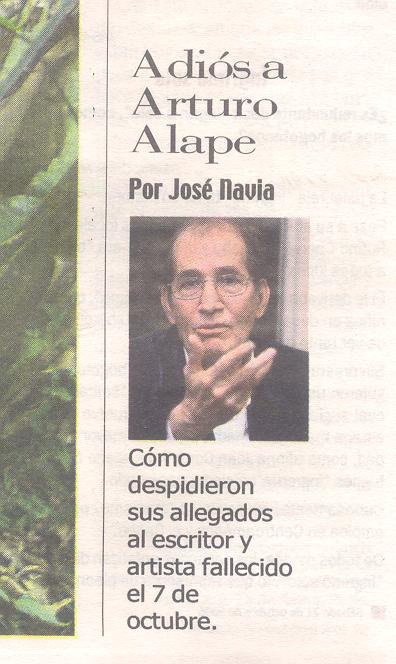 Arturo Alape, the chronicler José Navia reminds the late writer
 Jose Navia, Features Editor of TIME
WEEKEND READING, TIME, October 21, 2006
eltiempo . com / tiempoimpreso / edicionimpresa / readings, October 20, 2006 Source
enlarged picture
On the right a fragment of the first page reads. ---->>>
The researcher died a few days in the capital, after enduring a sad disease for several months.
bullets were not dark shooters, or sadness that historically have said for several years, they closed the coffin of Arturo Alape. In the first received votes and death notices that forced him into exile twice. But they were not his enemies who took him away on 7 October. It was leukemia. That disease cornered him for 7 years and decreased strength to the final ambush. The response of the writer, since he learned of his illness, was to intensify their working hours and their will to live. "I started the new novel, I have planned an exhibition of my paintings next year, the beginning of each night hug my daughter Paloma and every day I think of lengthening the steps of life " said in 2005, in an interview following the launch of a book.
In his later years, Alape wrote as if it were to die. In fact, six of his 23 books correspond to the time of his illness. The last of them, the unburied dead, hit bookstores in mid last year. It is the story of a woman who is fighting a courageous battle solve the murder of her husband. Alape himself described this work as a historical novel detective narrative structure.
Alape, who really was called Carlos Arturo Ruiz, was a Cali of 1,939. Adopted the name as a tribute to James Prías Alape, agrarian leader, founder of the peasant guerrillas that led to the FARC, killed in Gaitania (Tolima), in 1960. Alape participated intensely in the mid-worker protests s. XX. He also loved boleros, Cuban son and salsa. Among its most tangible memories of youth was in the old Cali salsa dancers, Apache botacampana white pants. So, nobody was surprised that Katia, his last companion, and Manuel, his son , also a historian, a recorder installed a few meters from his coffin in the room vigil. It was a way of extending the social gatherings organized writer in the living room of his apartment in the La Soledad.
to 19, by Alberto Beltran, his favorite, began the final serenade. "0ooye, what I mean ... there are dates in life, we can never, ever forget ..." . Some of his crate, his friends, because I had the good fortune to have several and true, they recalled the political adventures they shared as Communist Party members, raids, arrests and the lanky lad heading towards the hill, with illusion of changing the world. They also recalled his return to the city, three years later, disillusioned by the blood emergency imposed by the armed struggle.
Then set your tent in another field. It became an emotional biographer Manuel Marulanda and the FARC, but with time became necessary and sufficient distance, to the extent not justified at this time, no war. As a writer, journalist and historian, Alape realized the unofficial history of the Colombian conflict for over 50 years, with the consequences thereof. He also left a painting in which the hallways are in the slums of Cali, the faces of working-class neighborhood streets and interiors of houses of Havana, where he spent his first exile.
three years ago, the U. Valley recognized her merits an honorary literature. In recent weeks, received tributes from the Council of Bogotá, its students, their friends who packed the theater La Candelaria, another of his homes, and, finally, who came to the vigil room to participate in the final gathering around his coffin. No Mass or prayers. For the day of his death, Alape not veiled, but remembered him.
bullets were not dark shooters, or sadness that historically have said for several years, they closed the coffin of Arturo Alape. In the first received votes and death notices that forced him into exile twice. But they were not his enemies who took him away on 7 October. It was leukemia. That disease cornered him for 7 years and decreased strength to the final ambush. The response of the writer, since he learned of his illness, was to intensify their working hours and their will to live. "I started the new novel, I have planned an exhibition of my paintings next year, the beginning of each night hug my daughter Paloma and every day I think of lengthening the steps of life " said in 2005, in an interview following the launch of a book.
In his later years, Alape wrote as if it were to die. In fact, six of his 23 books correspond to the time of his illness. The last of them, the unburied dead, hit bookstores in mid last year. It is the story of a woman who is fighting a courageous battle solve the murder of her husband. Alape himself described this work as a historical novel detective narrative structure.
Alape, who really was called Carlos Arturo Ruiz, was a Cali of 1,939. Adopted the name as a tribute to James Prías Alape, agrarian leader, founder of the peasant guerrillas that led to the FARC, killed in Gaitania (Tolima), in 1960. Alape participated intensely in the mid-worker protests s. XX. He also loved boleros, Cuban son and salsa. Among its most tangible memories of youth was in the old Cali salsa dancers, Apache botacampana white pants. So, nobody was surprised that Katia, his last companion, and Manuel, his son , also a historian, a recorder installed a few meters from his coffin in the room vigil. It was a way of extending the social gatherings organized writer in the living room of his apartment in the La Soledad.
to 19, by Alberto Beltran, his favorite, began the final serenade. "0ooye, what I mean ... there are dates in life, we can never, ever forget ..." . Some of his crate, his friends, because I had the good fortune to have several and true, they recalled the political adventures they shared as Communist Party members, raids, arrests and the lanky lad heading towards the hill, with illusion of changing the world. They also recalled his return to the city, three years later, disillusioned by the blood emergency imposed by the armed struggle.
Then set your tent in another field. It became an emotional biographer Manuel Marulanda and the FARC, but with time became necessary and sufficient distance, to the extent not justified at this time, no war. As a writer, journalist and historian, Alape realized the unofficial history of the Colombian conflict for over 50 years, with the consequences thereof. He also left a painting in which the hallways are in the slums of Cali, the faces of working-class neighborhood streets and interiors of houses of Havana, where he spent his first exile.
three years ago, the U. Valley recognized her merits an honorary literature. In recent weeks, received tributes from the Council of Bogotá, its students, their friends who packed the theater La Candelaria, another of his homes, and, finally, who came to the vigil room to participate in the final gathering around his coffin. No Mass or prayers. For the day of his death, Alape not veiled, but remembered him.


0 comments:
Post a Comment