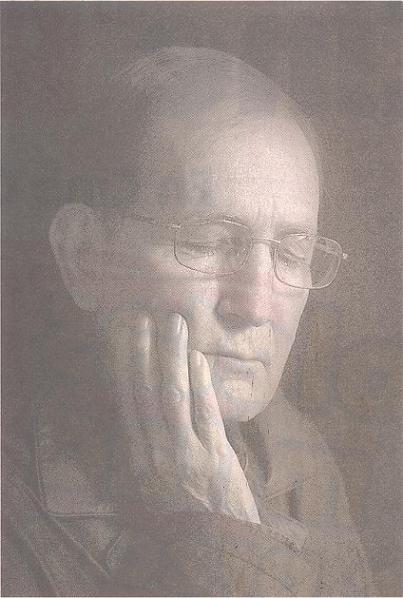
 This picture, taken by Carlos Duque months before the death of Arturo Alape becomes the best tribute to the painter and writer Cali, who died on 7 October. (Photo and Text in El Pais, Cali, Sunday, October 15, 2006 (pág.D-26). Living, Voices & murmurs.)
 --- ADIOS TO A LARGE
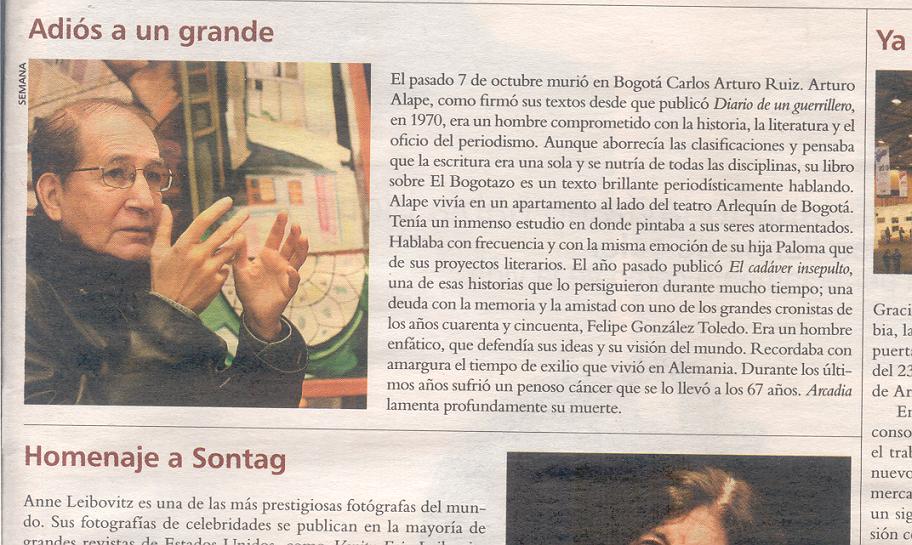
GOODBYE TO A GREAT MAGAZINE ARCADIA, No. 13 October 2006. P. 5
On October 7 died in Bogotá Carlos Arturo Ruiz. Arturo Alape , as he signed his texts since a guerrilla Journal published in 1970, was a man committed to the history, literature and d craft of journalism. Although he hated the rankings and I thought the writing was a lonely and fed on all disciplines, his book on The text is a brilliant Bogotazo journalistically speaking. Alape lived in an apartment next to the Harlequin Theatre in Bogota. He had a huge study where he painted his tormented beings. He spoke frequently and with the same emotion of his daughter Paloma on his literary projects. Last year he published The unburied corpse, one of those stories that he was persecuted for a long time, a debt to the memory and friendship with one of the great writers of the forties and fifties, Felipe González Toledo. He was emphatic, defending their ideas and vision of the world. He remembered with bitterness the time of exile who lived in Germany. In recent years suffered a painful cancer that took him to 67 years. Arcadia deeply regret his death. + + +
PARTNERSHIPS FOR COCA-COLA CRIMINAL
Iván Cepeda Castro fm_cepeda@yahoo.fr
THE SPECTATOR, October 14, 2006
http://www.elespectador.com/elespectador/Secciones/Detalles.aspx?idNoticia=1029&idSeccion=25
... ( At the end of the column)
Arturo Alape is one of the creators of human memory in Colombia. In his last months, in addition to the penalties that caused the disease, had to fight a legal battle with its EPS to purchase needed medications. Another of the outrages of the private system of "health." His literary work is a testimony of historical truth. ---
Alape Memories
Blackboard. Victor Rojas Dius
El Pais, Cali, October 16, 2006 http://www.elpais.com.co/historico/oct162006/OPN/piza.html
Three vignettes about the same event.
First, a police officer watched helplessly Armerillo looting of a small headquarters near Government House. He knows that any negligence can garner popular anger and he prefers to play dumb. Suddenly, one of the robbers, not satisfied with the gun, decides to go for a pair of boots. The officer pleads: "Take what you want, but not my drugstores." Who
tells the story, and is leading the assault, laughs.
Second: in the mutiny, and most likely in a main road, raining down from the windows, desks, chairs, filing cabinets, telephones, floor lamps and paper. Below, the crowd begs for more and more. A typewriter flies to run into the platform. A man is expected to others and makes the metal wallet. When everybody thinks they will leave with her as booty, the type of lifts and drops so violently that some pieces out of place. Then, systematically, a gesture again and again until exhaustion.
character asks himself if this is anarchy pure.
Third, it is dawn and the outlines of a squad of armed men are portrayed on the hills that serve as background. The fog obscures what lies behind the sound of an engine running ahead. Fear can be said that an army tank. All are placed in a firing position. The most inexperienced are still standing. Two lights in the background of the road.
Stop!, Shouting that still have a voice. Threatens to leave the car over them. There are some warning shots and the driver turns the tide to climb on a pile of rubble. Come out with your hands up! "Shouts one of the soldiers of the picket. A man and two women, few clothes and modesty, peer through the gates and surrender in the midst of their own laughter. All three are more drunk than a legion of Cossacks.
"This is not serious," thinks the same character.
are stories of April 9, 1948 and have two common elements: Fidel Castro, who goes from laughter to the decision to move to Bogotá because it seemed "not serious" what happens. So she told Arturo Alape many years.
Arturo Alape or Carlos Arturo Ruiz, his real name, was more than the biographer of Manuel Marulanda Vélez. There are your memories of Oblivion. Memories with which managed to prevent the assassination of Gaitán out step routine for generations later.
His technique to reconstruct one by one all the aspects of the assassination, with the voices of all parties to the conflict and no arabesques, totally far visceral lessons about Goths and clubs with which we grew up and where much hatred and trouble from haunt us today.
I am satisfied that Arturo Alape has died in his bed at the age of 67. And though it hurts his death, because he left the freelance writer and contradict the unofficial history of this country, I feel better if you have loaded the leukemia and not their enemies, those who dreamed of him lying in a street, shot dead in the back. The man flew them forever.
Paloma
A hug his daughter.


0 comments:
Post a Comment